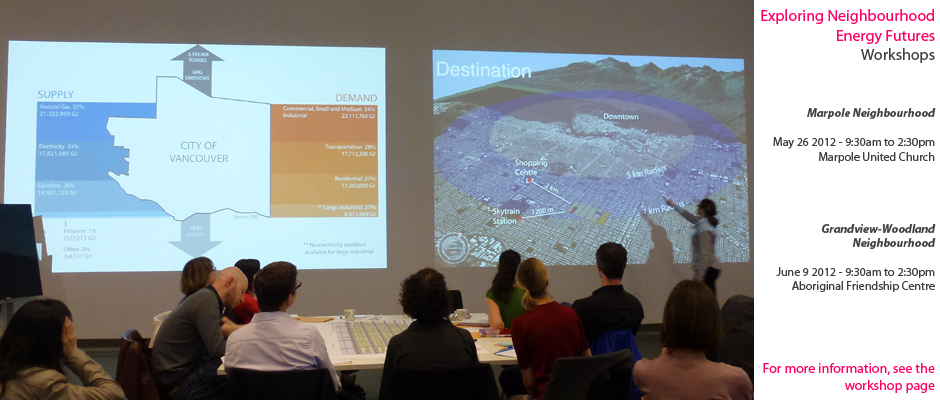
Exploring Neighbourhood Energy Futures


Join us for a hands-on workshop exploring community energy, neighbourhood design, and quality of life issues, as part of the Marpole, and Grandview-Woodland neighbourhood planning processes.

These workshops will help residents include Vancouver’s Greenest City goals for Climate Leadership, Green Buildings, and Green Mobility into the neighbourhood planning processes.  Learn more.

The Greenest City Conversations Project

Until recently, the dominant trend in both research and practice on the promotion of sustainability behaviour has been to focus on the provision of information in order to change people’s attitudes, beliefs, and subsequent  individual behaviour (Gardner and Stern, 1996). These interventions were based on an information deficit model, which suggested that provision of new information was a major driver of behaviour change (cf. Ajzen and Fishbein, 1980).

Decades of research have demonstrated, however, that there is a very weak relationship between the provision of information and sustainability behaviour (Hines et al., 1986/1987; Stern, 2000). Research has also shown that that people are particularly resistant to changing individual behaviours and habits that they see as impacting their quality of life (Bord et al., 2000; Shove, 2003).

Continue reading “The Greenest City Conversations Project”

Recruiting Android users for GCC mobile app research, March 31-April 14

The Greenest City Conversations Mobile Channel research group is looking for study participants (Metro Vancouver area only) for empirical research  into mobile apps and location awareness. And, you can win an iPod Touch if you participate.

What will participants do? They will beta test a sustainability challenge application for two weeks (March 31-April 14), comment about the experience, and complete two online surveys (one at the start, and one at the end). Some participants will use the Facebook version of the app, while some will use an Android version they will install to their Android smartphone. Android users will also agree to have their location tracked for the two week period (Android users’ personal location data are not exposed to Facebook nor made public. Location data are anonymized for the purposes of analysis and any future publication of the research). All data is stored on Canadian servers.

All participants must have a Facebook account (we use it to authenticate users in both versions of the app). None of your data in the app is shared with Facebook – you have the choice to have all of your participation in the app viewable by “Only Me”.

We need Facebook and Android users in roughly equal numbers. After 50 Facebook users have signed up, we will only be recruiting Android users, until their number also reaches 50. Then we will open the study up to more Facebook users.

Those who complete the full cycle of required app testing and complete two online surveys get entered into a draw for an iPod Touch. There will also be runner-up prizes of lesser value.

If you are interested in participating, please send an email to jeanhebert at sfu dot ca with the following information:

(1) “Mobile GCCP app” should appear in the subject line;
(2) your name;
(3) the email address you use for Facebook; and
(4) whether you have an Android device (by indicating this you put yourself in the Android group).

Once you’ve indicated your interest, we’ll add you to our list of potential participants and send you more detailed information about what the study involves. Once we’ve reached a critical mass of potential participants (expected by early next week), we’ll send you all a link to the informed consent and entrance survey (which must be completed by March 31st, and must be done before you can install the app).

Thanks for your attention!

Art & Sustainability @ CIRS

Please join us on March 18!  Visit our facebook page.

A few words from the artists ….

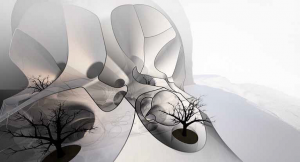
From Architect Derek Kaplan

What follows began with an open-ended question about the relationship between architecture and sustainability.  

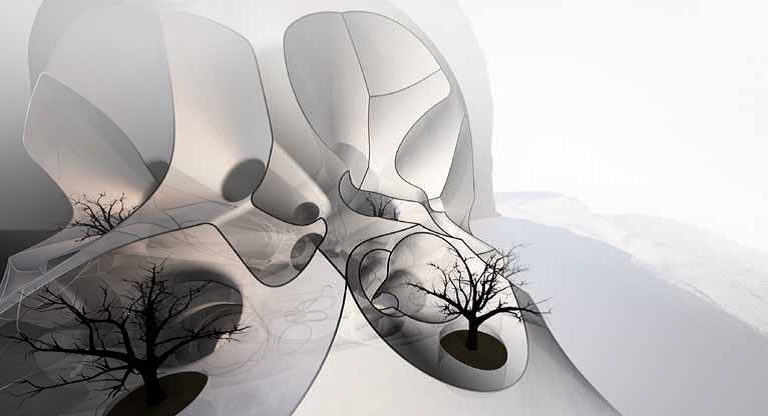
Standard “green” procedure formulates what architecture can offer sustainability in the terms of energy efficiency, recycled building materials, renewable energy sources, life cycle costs, material embodied energy, urban density and economies of scale, revised patterns of habitation and transportation, spaces for localized production of necessities like potable water, urban gardening/farming, etc.  All these issues are, and increasingly will be, important to address.  However, these bracketed lines of problem-solving respond to questions that are structured by the conceptual foundations of modern architecture, in which design possibility is defined by a functional positivism that prioritizes system optimization above all else.  There are other forms of architectural thought which start from different kinds of premises — the history of architecture demonstrates many — and that lead to architectural possibilities that are difficult destinations to access through the logic of modern architecture.  The architecture of this proposal is one such possibility that falls outside of modern architectural thought, in which value leads function, instead of function leading value.

The proposal begins by resurrecting the possibility of large-scale rock-cut architecture by means of a technological update to its method of production, using currently existing technology.  It is not a general concept for rock-cut architecture as a material means of producing our cities.  Rather it is for the production of one very specific piece of architecture that is currently absent:  a venue for future global environmental summits that is fundamentally other, a space removed from every context mapped by standardized habits — to offer an architectural starting point for addressing the fundamental antinomy between sustainability and the lifeworld as structured by capitalism.  The exhibition hopes to articulate a few key features of the question that leads to this as the answer.

From Giorgio Magnanensi

Teatro dellUdito /CIRS
for violin, viola, cello, double bass, 10 spatialized electronic musicians, live interactive video and live electronics.

This piece is a further investigation of my teatro dell’udito series, which explores techniques of collage and assemblage of heterogeneous forms with a programmatic character. The fragmented nature of these events underlines their character of work in progress: a sort of tale without beginning and ending, a permeable space declaring its non-obstruction to diverse voices and soundscapes.

I’ve been working for some time exploring the possible interactive connections between movement, sound and video with the goal of developing a portable and self-contained system which could allow me to perform live with an instrumental ensemble, a dance company, any group of people or all these things together. With this project I would like to further develop aspects of the collaborative process involved in the creation of a new work and implement an efficient and flexible computer based system for an interactive and generative audio-visual instrument, which would allow audience member to engage on an active role in the co-creation of the soundscape.

With this project I would like to expand the level of interactivity beyond a purely technical (sound) level to one where both performers and audience are fully aware of how their movements are affecting the environment and of what that means in a formal context which articulates a synesthetic “zone” which modularity allows for greater flexibility and self-generative processes. The resulting sound texture is not merely the addition or subtraction of a number of isolated events, but is a more complex combination of sound events that works in a strategy of an imaginary scenography: a scenography informed by a continuous search for original relations between movement, space (psychological one included) and sound.
 

Art & Sustainability @ CIRS

An evening of New Music and New Visual Work

explore the evolving relationship between art and sustainability

at UBC’s Centre for Interactive Research on Sustainability

Event Opening | Sunday March 18 | 8 pm

CIRS on UBC campus, 2260 West Mall | Admission is free


City of Vancouver Responds to Results of GCC Facebook Event

Participants of Exploring Vancouver’s Transportation Future have been heard by the City of Vancouver!

Transportation 2040 staff have written a response to each of the nineteen recommendations put forward by participants of the Facebook event hosted by Greenest City Conversations, in partnership with the City of Vancouver.

Read the Transportation Department’s response to participant recommendations (pdf).

Read the City’s summary of their overall consultation efforts (pdf). Continue reading “City of Vancouver Responds to Results of GCC Facebook Event”

GeorgiaStraight.com on GCC’s Facebook Transportation Discussion

Vancouver’s lifestyle and entertainment weekly newspaper, the Georgia Straight, published an online article about Greenest City Conversation’s newest research project – a Facebook based public conversation about the City of Vancouver’s Transportation Plan.

Stephen Hui, web editor and technology editor at the Georgia Straight, interviewed researcher Susanna Haas Lyons about the project. 
Continue reading “GeorgiaStraight.com on GCC’s Facebook Transportation Discussion”

Facebook Transportation Discussion

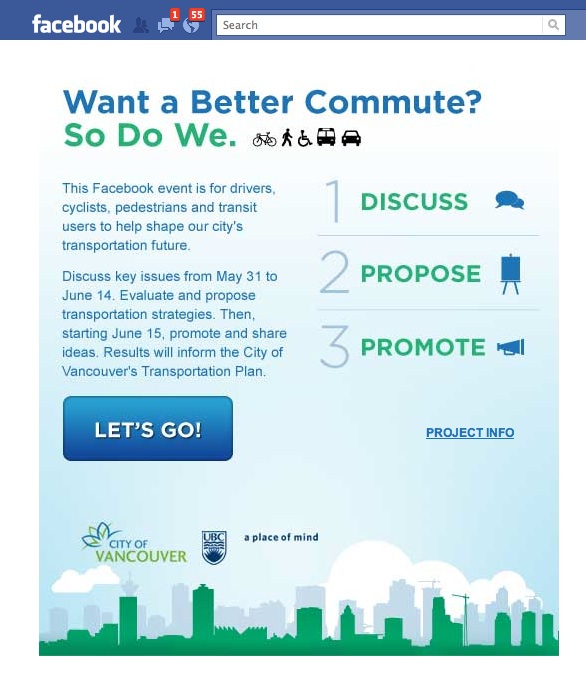
Exploring Vancouver’s Transportation Future has just launched, inviting Vancouver residents and commuters to contribute their ideas in a Facebook conversation that will help shape the City of Vancouver’s Transportation Plan.

Apps.Facebook.com/VanTransportFuture

We all get around the city. What will be the easiest, safest, most affordable ways to travel? This converation will help set direction for the next 30 years of Vancouver transportation.
Continue reading “Facebook Transportation Discussion”

GRAND Conference Presentations